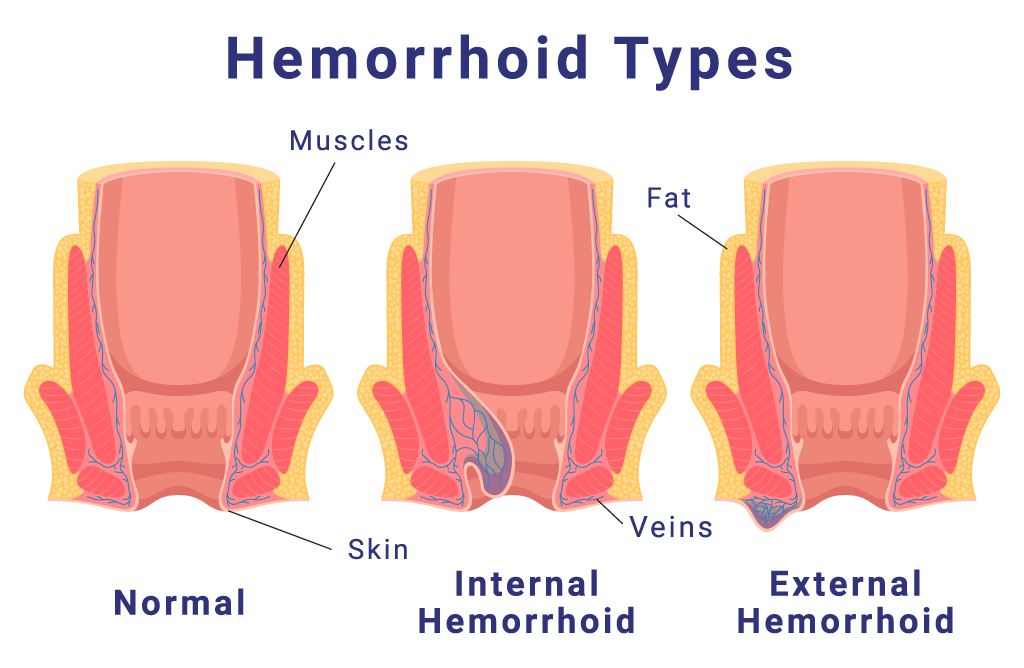
What are my treatment options for chronic hemorrhoids?
Conservative Treatment
Initially, conservative treatment for hemorrhoids should be attempted. These can include everything from dietary changes to over-the-counter treatments and sitz baths. NSAID pain relievers (such as Tylenol or Advil) may be used to control pain. If the symptoms persist, and if you are experiencing pain, bleeding or changes in bowel habits, you may wish to speak with your doctor about treatment options.
Surgery
In some cases, surgery may be required to treat chronic hemorrhoids, especially if you have grade IV prolapsed internal hemorrhoids or if you experience strangulation (blood flow to the hemorrhoid is completely cut off). Hemorrhoidectomy is the surgical removal of hemorrhoids. Stapled hemorrhoidopexy is the surgical repositioning of prolapsing internal hemorrhoids. Surgery involves a longer recovery and postoperative pain.
Rubber Band Ligation
A less invasive procedure known as rubber band ligation is another way to treat grades I – III internal hemorrhoids. During the procedure, a small rubber band is placed around the hemorrhoid, cutting off its blood supply. Because the procedure is performed within the rectum, recovery from rubber band ligation can be painful or uncomfortable and cause bleeding. Large or multiple hemorrhoids often require treatment over several visits. Furthermore, people on anticoagulant or antiplatelet drugs are at a significantly higher risk for post-operative procedure bleeding.
Hemorrhoidal artery embolization (HAE)
This minimally invasive procedure is rapidly gaining popularity for several reasons. First, it is not performed through the rectum so the painful recovery is avoided. It is performed through a small puncture in the wrist or groin (similar to a blood draw) to access the bloodstream. Additionally, it is highly effective, even for large or multiple hemorrhoids.